


 English
 中文简体
中文简体 Español
 عربى
عربىIndustry News
Home / News / Industry News / How to Read a Connector Datasheet: Key Parameters Explained for Engineers and Buyers
Every connector project starts with a datasheet — yet datasheets are often skimmed, not studied. Between the marketing-friendly hero specs and the fine print lie the numbers that actually decide whether your product survives the field. Here is what to look for, and what the numbers really mean.
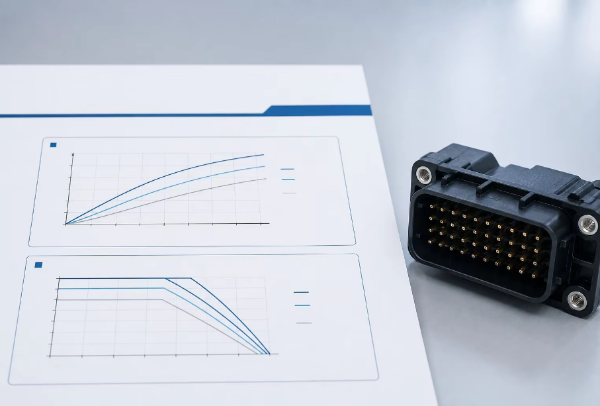
1. Rated current (per pin). A "3A connector" rating almost always refers to one pin, at a defined ambient temperature (usually 25°C or 85°C). When all pins are loaded simultaneously, the effective limit drops — often by 40–60%. Always cross-check the derating curve, not just the headline number.
2. Contact resistance. Expect initial values of 10–30 mΩ for signal contacts and below 10 mΩ for power contacts. The number matters less than its stability: a good datasheet specifies a maximum after 100 mating cycles, which predicts long-term reliability far better than the initial value.
3. Insulation resistance. Typically ≥100 MΩ minimum (often 1,000 MΩ). This is a safety-oriented parameter — it tells you how well the housing prevents leakage between adjacent circuits under humid conditions.
4. Dielectric withstanding voltage (Hi-Pot). Usually expressed as "500 V AC for 1 minute." This confirms the air gap and creepage path inside the housing can survive transient overvoltage without arcing.

1. Confirm the rated current is given per pin and note the reference ambient temperature.
2. Look for a derating curve — absence is a red flag for a quality supplier.
3. Verify the test standard behind each number (EIA-364 series is the usual basis).
4. Check tolerances, not just nominal values — plating thickness, insertion force and coplanarity all carry tolerances that affect your assembly line.
5. Request the material declaration (RoHS/REACH) page if you sell into the EU.
A reliable manufacturer provides datasheets with tolerance stacks, derating curves, and traceable test standards — not just marketing numbers. When in doubt, ask for the third-party test report behind any headline spec.


Copyright © Zhejiang Wenda Electronics Co., Ltd. All Rights Reserved

Custom Electronic Connectors Manufacturer

